Showing posts with label information. Show all posts
Showing posts with label information. Show all posts
Sunday, 20 September 2015
Exploitation producing vegetables for the US.
This is a very insightful documentory into the lives of workers in Mexico who grow vegetables for Mexican and US markets. Beware Americans, some of your vegetables are grown by these people. They are subjected to varying degrees of exploitation, bad labour conditions, poor wages, and sometimes, literal slavery.
But you don't really care where vegetables come from. Why should you care?
If you are an American, your country abolished slavery, and is not the most powerful and prosperous nation on earth, but every restaraunt, every high rise building, every clothing store, every accomplishment in America is still built on the backs of slaves.
I wonder, will the US will ever cease to be a land built on the backs of slaves?
If you are human, you are related to these people. These children picking chillies in the feild. The little boys who will never drive their dream car and possably never own a car at all. The little girls who sit in a hot, dark room all day, who can't read or write or go to school. Their mother who hurts every time she leaves them there, but is terified somebody will kidnap or harm them and has no other option. Imagine the shame within her that she can't do any better for her children. That isn't soley her fault, it's societies problem. We allow a situation to exist where these children will never be able to do anything more than pick whatever vegetable and take whatever meagre amount they can get to feed their families if we cannot change their cicumstances.

Sunday, 6 September 2015
Saturday, 29 August 2015
Help combat human trafficking - Live Below the Line with me!
Here's a way you can help to combat human trafficking - live below the line.
Live below the line is a challenge where first world people buy all our food for the equivelent of the extreme poverty line. It used to have an acronim of LBL which is quite unfortunately associated with something else. (Google it).
Let us not use that.
The extreme poverty line (Thanks year 12 social studies) is an amount of money; whatever is trading at the equivelent of $1.25 USD. People below the line live in many different countries and circumstances, but people who have less than this to pay for their living expenses per day, are living below the line. The problem is that currencies are not all worth the same amount of money, and the cost of living varies a lot from place to place, which is why I don't like defining poverty by how much money you have. I've seen that poverty is more than the lack of money. Poverty is the lack appropriate living conditions, and, too often, the lack of hope.
But, I do like 'live below the line' because it gives us a taste of what a struggle life is for these people.
I did live below the line, I think about three years ago. Now I'm doing it again.
I'll be blogging my experience, videos, information, and my menu, here, and on my live below the line page.

Live below the line is a challenge where first world people buy all our food for the equivelent of the extreme poverty line. It used to have an acronim of LBL which is quite unfortunately associated with something else. (Google it).
Let us not use that.
The extreme poverty line (Thanks year 12 social studies) is an amount of money; whatever is trading at the equivelent of $1.25 USD. People below the line live in many different countries and circumstances, but people who have less than this to pay for their living expenses per day, are living below the line. The problem is that currencies are not all worth the same amount of money, and the cost of living varies a lot from place to place, which is why I don't like defining poverty by how much money you have. I've seen that poverty is more than the lack of money. Poverty is the lack appropriate living conditions, and, too often, the lack of hope.
But, I do like 'live below the line' because it gives us a taste of what a struggle life is for these people.
I did live below the line, I think about three years ago. Now I'm doing it again.
I'll be blogging my experience, videos, information, and my menu, here, and on my live below the line page.

Thursday, 4 June 2015
Slavery?
Slavery.
When you think of slavery, maybe you imagine the "black" slaves of historical America. Or the people in movies, beaten with stock whips and forced to work long hours for stale bread and some ragged clothing. The skinny men who lived in your history books at school, pulling chariots wearing only ragged cloths.
Or, perhaps, like I do, you think of modern day slavery.
Who are these slaves?
"Slavery; - a condition of having to work very hard without proper remuneration or appreciation." -Google definition
In our Western societies, historically, our ancestors had slaves. But because the practice of slavery has been made illegal, we no longer see our slaves. A wealthy family will no longer leave slaves to the next generation in their will. It's illegal to beat and mentally abuse our slaves to get more production out of them. We don't buy and sell people. It's highly illegal! And we are a society which believes it is wrong.
So how come slaves had to sew your clothes, and grow and weave the cotton? Slaves had to mine the minerals that went into your make up and the metals that went into your phone. Slaves had to pick the tea and process the coffee and harvest the cocoa you drink. Slaves living at your house are illegal. If you were found to have people working at your house who were paid less than the minimum wage, especially if you were coercing them and forcing them to stay there, you could go to prison for it. But, strangely, it's legal to import items made by slaves. You have slaves, who just happen to live in different countries.
How do people become slaves? -Scams that cost lives.
People become slaves in a few different ways.
Quite commonly, slaves start out as teenagers living in impoverished and rural areas of the world. 'Agents' come to them offering jobs in large, exciting cities and even other abroad. Young people the world over long to explore the world and have adventures. These teenagers are often (although not always) in situations where they couldn't otherwise afford an OE. Another attraction of course, is being able to have money, and send some back to their parents. The teenagers don't know that these jobs will not be paid, and that they will be mistreated and intimidated to believe they cannot leave.
A 14 year old girl named Radhika who worked selling vegetables in Kathmandu, Nepal, was told by a man she had come to trust that he could get her a better job as a housekeeper for a rich family across town. The family told her to come on "holiday" with them, and that was the beginning of several years of trafficking and slavery for Radhika. Her story is told in full in "Radhika's Story" by Sharon Hendry.
It's also common in some countries, for the parents to be the targets of these scams. Told their child will be taken to schools, or to a legitimate job, and that they will receive a commission for sending them. Some of these situations are described in the 2010 documentary "Stacey Dooley investigates Sex trafficking in Cambodia". Sometimes loan sharks will ask for a person as security for a loan, and will kidnap the person if the loan cannot be repaid.
I'd like to point out that this trafficking of people into slavery doesn't exclusively happen in developing countries, doesn't exclusively happen to young people, and doesn't exclusively happen to women. Anyone can be a target. Europe and the USA have seen numerous cases of human trafficking (See the example in the next paragraph). “Worldwide, almost 20% of all trafficking victims are children. However, in some parts of Africa and the Mekong region, children are the majority (up to 100% in parts of West Africa).” -United Nations Office of Drugs and Crime article.
How are people kept slaves?
Slaves can be physically locked up, but a more powerful way of keeping people slaves is by physical violence and threats. "Nichole's Story" a three minute video you can watch on the A21 website, is about an American woman, who was a slave in America. She tells in the video of how her captor "brutally beat" another victim in front of her and threatened her that "If I ran off and left him, he would hunt me down, and murder me, and murder my family." He wouldn't let her have a cell phone, or call her family without him being in the room.
Many slaves are bonded into labour; after their coercion, they are told they owe money; "recruitment fees" and "accommodation costs" are common, and must work to pay it off. The traffickers ensure that the slaves will never pay their fees by not providing enough income.
When slaves are transported across cultures, they often don't speak the language of the people around them, and don't know the laws of the country and so are isolated enough to keep them in captivity.
How can we create freedom?
When I have a good reason to believe something has been made by slaves, and I don't really need it, I try not to buy it. If many people are vegans to avoid the exploitation of animals, I wonder why there aren't many people who will do the same thing to avoid exploitation of people.
Since I started boycotting certain products, I've had to find substitutes for the things I used to buy. Often these substitutes are Fair Trade or otherwise certified, which means the producers at the bottoms of supply chains in other countries get a fair price. Often the money made purchases also goes toward establishing things like schools to better their communities. Another solution I like is to buy things second hand. The items may have been made by slaves, but their original purchasers no longer need them. I'm recycling them, they are often still in good condition, and I don't have to pay too much. I like to think the money I save at the second hand shop, I can spend on fair trade products.
Sometimes Boycotting isn't practical. There might not be an ethical substitute that is readily available, and it might not be a product we can just live without. So, we can sign petitions, and write letters, and emails, and to the companies making the products, asking them to make an ethical substitute available. This re-channelling of demand shows companies the need to find better supply chains. A group working to establish ethical supply chains is made in a free world.
You can also support an organisation working to help victims.
Luckily, Many organisations that work hard to help people get out of slavery, and there are many ways to help. Some groups help by providing a safe place for newly freed slaves to recover. Some groups help prosecute traffickers. Some groups run community awareness programmes telling people about the dangers of falling victim to scams, or provide education, and relieve poverty to prevent trafficking.
Because many of these groups are not for profit, by donating money, or organising a fundraiser, you enable them to keep doing what they're doing. You may even be able to volunteer to help them yourself. There is a need for different kinds of workers, with many different kinds of skills to go as volunteers.
Or raise awareness.
Tell other people about slavery, and they can make a difference too. Share this article and blog with your friends. Share charities and ways to help with your friends, or ask everyone you know to write to a company with you.
Or pray for the victims, and the work to combat modern day slavery.
"You may choose to look the other way, but you can never again say that you did not know." -William Wilberforce
"You may choose to look the other way, but you can never again say that you did not know." -William Wilberforce
Saturday, 4 October 2014
Know the issues; sugar
Sugar.
Sweet, fattening, diabetes inducing sugar.
While we know it's unhealthy and wish we didn't, most of us eat a lot of sugar.
I don't know about you, but my family has always bought the cheapest bag of sugar from the supermarket shelf. But it would have so much of a better effect on the producers of our sugar if we could buy fairly traded organic sugar instead.
Our demand for cheap sugar creates a demand for sugar to be grown cheaply. Although countries like the US and Australia grow sugar cane, many other countries that grow it are "developing countries" The demand for cheap sugar creates a demand for cheap labour. In many cases people are exploited to harvest it.
One example is Dominican Bateyes.
In the Dominican Republic, migrants from Haiti, more recently, the children of migrants, make up a large amount of the workers for sugar plantations. Most of these plantations have company housing called bateys. These bateys are often badly maintained, and often there is limited access to health care or school, meaning the children born there end up in a cycle, having no other choice but to work in the same industry as their parents. The pay is not very good, and people do not have the means to get out.
Bateyes, and batey like places exist in other countries. In many other countries where sugar is grown, people have similar problems. Our desire for the cheapest sugar available doesn't help the equality of these workers.
There are some groups and charities working to improve conditions in these places. We can donate to these chatities to help, but when we are buying the product, we have an opportunity to make difference. Buying fairly traded and organic sugar means more money can be spent on labour which provides income for farmers and farm workers. It's also a good idea to look for co-operatives that fund community projects like medical care, school uniforms, and education. Most fair trade products come from such co-operatives. It's also worth while finding out what country your sugar is grown in.
Sources and more information;
http://www.huffingtonpost.com/john-j-powers/dominican-bateyes_b_1547082.html
http://www.thebateyfoundation.org/about/
http://bateyrelief.org/work/
Sweet, fattening, diabetes inducing sugar.
While we know it's unhealthy and wish we didn't, most of us eat a lot of sugar.
I don't know about you, but my family has always bought the cheapest bag of sugar from the supermarket shelf. But it would have so much of a better effect on the producers of our sugar if we could buy fairly traded organic sugar instead.
Our demand for cheap sugar creates a demand for sugar to be grown cheaply. Although countries like the US and Australia grow sugar cane, many other countries that grow it are "developing countries" The demand for cheap sugar creates a demand for cheap labour. In many cases people are exploited to harvest it.
One example is Dominican Bateyes.
In the Dominican Republic, migrants from Haiti, more recently, the children of migrants, make up a large amount of the workers for sugar plantations. Most of these plantations have company housing called bateys. These bateys are often badly maintained, and often there is limited access to health care or school, meaning the children born there end up in a cycle, having no other choice but to work in the same industry as their parents. The pay is not very good, and people do not have the means to get out.
Bateyes, and batey like places exist in other countries. In many other countries where sugar is grown, people have similar problems. Our desire for the cheapest sugar available doesn't help the equality of these workers.
There are some groups and charities working to improve conditions in these places. We can donate to these chatities to help, but when we are buying the product, we have an opportunity to make difference. Buying fairly traded and organic sugar means more money can be spent on labour which provides income for farmers and farm workers. It's also a good idea to look for co-operatives that fund community projects like medical care, school uniforms, and education. Most fair trade products come from such co-operatives. It's also worth while finding out what country your sugar is grown in.
Sources and more information;
http://www.huffingtonpost.com/john-j-powers/dominican-bateyes_b_1547082.html
http://www.thebateyfoundation.org/about/
http://bateyrelief.org/work/
Tuesday, 10 June 2014
Know the issue; Human conditions in cocoa production
To see the first part to this series;
In the previous part of this series, I gave some basic information on what cocoa is. In this part I will be giving information on the ethics of producing cocoa. Because a lot of work is involved to produce cocoa, it is not easy to produce it cheaply. There are concerns that low market prices of cocoa can drive producers into poverty, and even cause some to resort to slave labour to make money.
A major issue people are becoming more aware of in cocoa production is human trafficking. Children are cheap labour. It is believed that children are sometimes kidnapped, sometimes sold by family members, and sometimes smuggled from nearby countries to work on cocoa farms in the Ivory Coast and Ghana. These children are not given proper training to handle the dangerous work involved in processing cacao. (Climbing up trees and cutting fruit down with machetes.) When every company is trying to make their chocolate cheap, it can actually be hard for farmers not to resort to this kind of practice to make their business work. Some people dispute whether cocoa slaves actually still exist. You are free to make you own mind up. In the film The dark side of chocolate, Ali Lakiss, the owner of Saf-Cacao, one of Ghana's biggest cocoa exporters, said "There are no children in the plantations." He obviously has a lot to gain from people believing that. Journalists have filmed children working in cocoa farms. Some children do so part time and also go school. But from what I have seen, I think theirs enough evidence to believe children are being, or have been exploited in cocoa production, and I feel we, those who eat chocolate, should do something about it.
When we buy chocolate, some of the money that companies make will go toward making more chocolate, right? So if you buy chocolate, how can you make sure it doesn't come from these farms that are enslaving people?
I know you want me to tell you what brands to buy, but I can't. There are many different solutions
#1. Fair trading
Fair Trade and other similarly labeled products are purchased from the farmers at more than a minimum Fairtrade price. People believe buying Fairtrade certified chocolate, means there are no issues with the production of the chocolate. Unfortunately, this is not true. Fairtrade chocolate is usually purchased from a co-op where all farmers are paid (and sometimes contracted to) a price. Fair trade can improve the living conditions of people who grow cocoa. This can have positive effects farmers who do the right thing. On their employees, employees' families, and their communities. However, we are worried that some farmers will sell their cocoa at a fairtrade price, and still use slaves. Most of the time the organisations that certify cocoa cannot completely make sure slaves are not used.
#2 Boycotting Ivory Coast Cocoa.
Ghana and the Ivory Coast are the only places where people claim cocoa slavery is happening. Many people boycott cocoa from the Ivory Coast and Ghana. The Food Empowerment Project has produced a comprehensive list of cocoa brands that buy cocoa from other areas like south America rather than Ghana and the Ivory Coast. They only research vegan products, but have a long list regardless. If there is a company that is not on the list, you can sometimes find information on their website or through sending them an email asking them. While this does provide us with a way not to impact the West African cocoa slaves, boycotting a country is only a temporary solution. Many people in West Africa do rely on the chocolate industry for income. Also, some of the other countries we buy cocoa from could have problems with exploitation, just less reported. What we eventually need to do is to work with producers.
#3 Direct action to improve conditions
The more direct relationship a chocolate producer has with farmers and small co-operatives that have good relationships with farmers, the more control we can have over their practices. In the past, companies have signed famous agreements promising to stop slave labour in West African cocoa farms. So far, not enough has been done. When media attention dies down, it's forgotten about again. If you want to encourage companies you buy from to do more, please send them annoying letters and emails. Some groups are starting to do this well, and to make a difference in the lives of farming families, but many do not.
I believe it is your responsibility to research this for yourself. I have been researching for years for myself. I am passionate about encouraging other people to make good decisions, and although I think my opinion is clear, I am not telling anyone else what to think. Chose which way you are most comfortable buying. But please don't do nothing.
Also visit;
http://www.slavefreechocolate.org/index.html
A major issue people are becoming more aware of in cocoa production is human trafficking. Children are cheap labour. It is believed that children are sometimes kidnapped, sometimes sold by family members, and sometimes smuggled from nearby countries to work on cocoa farms in the Ivory Coast and Ghana. These children are not given proper training to handle the dangerous work involved in processing cacao. (Climbing up trees and cutting fruit down with machetes.) When every company is trying to make their chocolate cheap, it can actually be hard for farmers not to resort to this kind of practice to make their business work. Some people dispute whether cocoa slaves actually still exist. You are free to make you own mind up. In the film The dark side of chocolate, Ali Lakiss, the owner of Saf-Cacao, one of Ghana's biggest cocoa exporters, said "There are no children in the plantations." He obviously has a lot to gain from people believing that. Journalists have filmed children working in cocoa farms. Some children do so part time and also go school. But from what I have seen, I think theirs enough evidence to believe children are being, or have been exploited in cocoa production, and I feel we, those who eat chocolate, should do something about it.
When we buy chocolate, some of the money that companies make will go toward making more chocolate, right? So if you buy chocolate, how can you make sure it doesn't come from these farms that are enslaving people?
I know you want me to tell you what brands to buy, but I can't. There are many different solutions
#1. Fair trading
Fair Trade and other similarly labeled products are purchased from the farmers at more than a minimum Fairtrade price. People believe buying Fairtrade certified chocolate, means there are no issues with the production of the chocolate. Unfortunately, this is not true. Fairtrade chocolate is usually purchased from a co-op where all farmers are paid (and sometimes contracted to) a price. Fair trade can improve the living conditions of people who grow cocoa. This can have positive effects farmers who do the right thing. On their employees, employees' families, and their communities. However, we are worried that some farmers will sell their cocoa at a fairtrade price, and still use slaves. Most of the time the organisations that certify cocoa cannot completely make sure slaves are not used.
#2 Boycotting Ivory Coast Cocoa.
Ghana and the Ivory Coast are the only places where people claim cocoa slavery is happening. Many people boycott cocoa from the Ivory Coast and Ghana. The Food Empowerment Project has produced a comprehensive list of cocoa brands that buy cocoa from other areas like south America rather than Ghana and the Ivory Coast. They only research vegan products, but have a long list regardless. If there is a company that is not on the list, you can sometimes find information on their website or through sending them an email asking them. While this does provide us with a way not to impact the West African cocoa slaves, boycotting a country is only a temporary solution. Many people in West Africa do rely on the chocolate industry for income. Also, some of the other countries we buy cocoa from could have problems with exploitation, just less reported. What we eventually need to do is to work with producers.
#3 Direct action to improve conditions
The more direct relationship a chocolate producer has with farmers and small co-operatives that have good relationships with farmers, the more control we can have over their practices. In the past, companies have signed famous agreements promising to stop slave labour in West African cocoa farms. So far, not enough has been done. When media attention dies down, it's forgotten about again. If you want to encourage companies you buy from to do more, please send them annoying letters and emails. Some groups are starting to do this well, and to make a difference in the lives of farming families, but many do not.
I believe it is your responsibility to research this for yourself. I have been researching for years for myself. I am passionate about encouraging other people to make good decisions, and although I think my opinion is clear, I am not telling anyone else what to think. Chose which way you are most comfortable buying. But please don't do nothing.
Also visit;
http://www.slavefreechocolate.org/index.html
Wednesday, 26 February 2014
End it.
Slavery, or human trafficking, is the main theme of this blog.
Slavery was 'abolished' in the US a long time ago, and now the African American people are no longer slaves. However, America, and every other western country, still has slaves. They just can't see them.
A slave is a person who is perceived as being owned by another person, forced to do work or carry out orders, and who is not sufficiently paid. The truth is, many of the goods western society consumes are made by workers in such conditions.
My blog focuses on food. Did you know that it is estimated more than 70% of the coco the in the world is produced in west Africa? Did you know that children are commonly sold or bonded to coco farms in throughout West Africa? Although the general public in these countries often think this is a myth, the evidence, in my point of view, that these children are trafficked in the chocolate industry is overwhelming.
In many places factories where people work long hours for less than legal wages. These people may not be 'owned' (although in some countries they are trafficked into the industry) Workers in China often come from far areas of their country to work in factories and have to live in factory dorm housing, rarely leaving the factory. They are paid very low wages per hours and often work overtime just to make money. Being tired and not having proper safety equipment means there will be accidents in the workplace.
Also there is a kind of slavery we don't all contribute to. Many young girls, younger than myself, are sold to brothels.

It is estimated there are 27 million victims of human trafficking in the world. Today, on the 27th of February, there was an awareness movement where people around the world who drew red Xs on their hands and told their friends about slavery. The X shows that they won't stand for slavery and want it to end. I joined them. And that's why I am putting up this blog post today. To shine a light on the invisible slaves of the world. The world has forgotten them, their pain, and their lives, but we know they are there. I won't allow them to be ignored any longer. I just told you.

Saturday, 15 June 2013
Know the issue; What is cocao?
In order to help people understand issues, I am beginning a series of blog posts which I hope will explain exactly what I am waffling on about.
Cocoa pods are fruit that grow on trees. The trees are called cacao trees or cocoa trees, and were first cultivated by the Olmecs in what is modern day Mexico. The trees grow up to 25 feet high. Cocoa pods were an important commodity in early South America. At one point they were used like a currency.
Cocoa pods don't ripen all at the same time, they turn from green to orange, and have to be monitored carefully and harvested individually using knives on long poles. After the ripened pods are cut, the beans and pulp are removed and left to ferment either in piles covered in banana leaves or in wooden boxes. Organisms and bacteria like yeast produce acids and gases that partially break down proteins and sugars in the bean. After about a week, the beans are dark brown. From there, the beans are sold to factories. Then they are roasted to remove bacteria and break down acids that would make the beans taste bitter.
After roasting, the nibs of the beans are ground into a paste called 'mass' The mass then goes through a powerful press, where it is separated into butter and powder. The powder can then be further refined, and occasionally anti caking agents are added to make cocoa powder for baking. Sugar and other flavourings are added to make drinking chocolate powder. To make solid block chocolate, hot cocoa butter is mixed into coco powder and other flavourings.
We are surrounded by cocoa, it is used in just about every product on supermarket shelves. From block chocolates and baking powders, to biscuits and muesli bars dipped in it and ice creams, yogurts, slices, cereals, and drinks that use it as flavouring.
Today it is estimated that between 69% and 95% of the world's cocoa are grown on trees in West Africa. (In Ghana and The Ivory Coast)
References; http://science.howstuffworks.com/innovation/edible-innovations/chocolate1.htm
http://nz.answers.yahoo.com/question/index;_ylt=AkC7IXQ3fxmdwPazK5dWdqHJZwx.;_ylv=3?qid=20130417115735AATM5xF
http://en.wikipedia.org/wiki/Theobroma_cacao
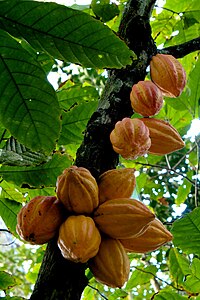 |
| The trunk of a Cocoa tree, picture from Wikipeadia |
Cocoa pods don't ripen all at the same time, they turn from green to orange, and have to be monitored carefully and harvested individually using knives on long poles. After the ripened pods are cut, the beans and pulp are removed and left to ferment either in piles covered in banana leaves or in wooden boxes. Organisms and bacteria like yeast produce acids and gases that partially break down proteins and sugars in the bean. After about a week, the beans are dark brown. From there, the beans are sold to factories. Then they are roasted to remove bacteria and break down acids that would make the beans taste bitter.
After roasting, the nibs of the beans are ground into a paste called 'mass' The mass then goes through a powerful press, where it is separated into butter and powder. The powder can then be further refined, and occasionally anti caking agents are added to make cocoa powder for baking. Sugar and other flavourings are added to make drinking chocolate powder. To make solid block chocolate, hot cocoa butter is mixed into coco powder and other flavourings.
We are surrounded by cocoa, it is used in just about every product on supermarket shelves. From block chocolates and baking powders, to biscuits and muesli bars dipped in it and ice creams, yogurts, slices, cereals, and drinks that use it as flavouring.
 |
| A dessert my class made in school using cocoa |
References; http://science.howstuffworks.com/innovation/edible-innovations/chocolate1.htm
http://nz.answers.yahoo.com/question/index;_ylt=AkC7IXQ3fxmdwPazK5dWdqHJZwx.;_ylv=3?qid=20130417115735AATM5xF
http://en.wikipedia.org/wiki/Theobroma_cacao
Subscribe to:
Posts (Atom)